His name was Spencer Silver, and in 1968 he was a chemist at 3M’s labs in Minnesota. He was looking for a very strong adhesive for building aircraft. What he got was something else: a weak glue made of tiny acrylic spheres that held lightly and peeled off without leaving a mark. It could be used again and again.
For the goal he had, it was a failure. For any other goal, nobody could say.
Silver spent the next five years showing the discovery around the company. He talked to colleagues, gave internal seminars, looked for someone who could see a use for it. He thought of a spray, he thought of a bulletin board where notes could be stuck and unstuck. None of the ideas caught on. He had a glue with unique properties and no problem for it to solve.
An unexpected use
One of the colleagues who sat in on those seminars was Art Fry. He sang in a church choir and had a small, recurring annoyance: the slips of paper he used to mark the hymns in his book kept sliding out and getting lost. In the early 1970s, he remembered Silver’s glue. A slightly sticky slip would stay put and come off without tearing the page.
The bookmark worked. And as he used it, Fry realized those slips worked better as notes, for leaving a message on a document, on a desk, on a report about to pass through other hands. With help from other colleagues, among them Henry Courtney and Roger Merrill, the glue was tuned to stick to paper and other surfaces and come off cleanly. Fry started handing out samples inside the company, and his colleagues couldn’t get enough of them.
The market was still missing. In 1977, 3M tested the product in four American cities under the name “Press ‘n Peel.” The results were disappointing, and production came close to stopping. The following year, the company tried something else in Boise, Idaho. It stopped waiting for people to find the product on the shelves and brought it to them instead, handing out free samples to offices around the city. About 90% of the people who got them said they would buy it. In 1980, Post-it Notes reached stores across the country.
Twelve years passed between the glue and the product. A good part of them was spent waiting for a question.
What Boise revealed
There’s a detail in this story worth more than the glue. For years, nobody could justify investing in a piece of paper that sticks and unsticks, because that need hardly existed in anyone’s head before the paper did. It would have been hard to find in a market study: people didn’t know they had it. What revealed it was a concrete use, a man who picked the thing up and tried it on a problem of his own. And later, thousands of people in Boise who did the same with a sample in hand.
Clarity about what the product was for came from the product being used. Until then, every conversation about whether it was worth the investment went around in circles.
The circle
Many design teams know that circle, even if they’ve never given it a name.
There are stretches when an organization decides to focus. Fewer fronts, fewer bets, more attention to what already exists and works. In those stretches, the rule for exploratory work is usually reasonable: it moves forward if there’s a validated need. Someone has to show that the problem exists, that it matters, and that it fits the strategy.
The difficulty lies in what that validation asks for. To say an exploration fits the strategy, you need a clear strategy about users, about the brand, about where the product wants to be a few years from now. Often that clarity is still being built, and leadership itself is searching for it. And one of the best ways to get there is precisely to explore: put something in front of people and see what happens.
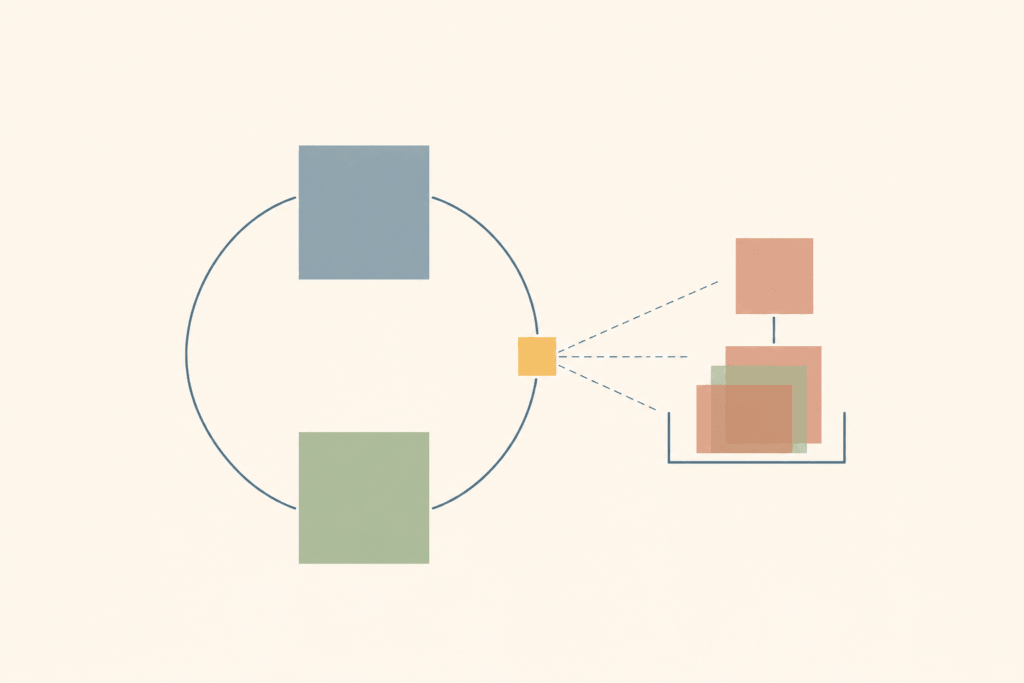
Exploration waits for strategy, and strategy, without knowing it, waits for exploration.
With AI, the circle has become easier to see. Design teams today have an energy they didn’t have a few years ago. They can prototype an ambitious idea in an afternoon, try a brand concept in several formats, build a working version of something that used to live on a slide. The capacity to explore has gone way up. The organization’s capacity to say whether those explorations matter has gone up a lot less.
How a team loses the will
The result is rarely a ban. Nobody says exploring is off-limits. What happens is slower and harder to see.
Someone proposes an exploration. They’re asked to show the need. They try, but the need depends on decisions nobody has made yet. The proposal goes on hold, looking for an owner to adopt it, and the owner is slow to show up. The second time, the proposal arrives smaller. The third time, it never gets made.
Silver had the persistence to spend five years presenting a glue nobody wanted. Hardly anyone has that kind of patience, and it would be unfair to demand it. A team that watches its explorations stall again and again learns a perfectly rational lesson: investing in them doesn’t pay off. And that lesson is hard to unlearn when the focus phase ends and the organization needs ideas again.
The history of penicillin shows another side of the same problem. In 1928, in London, Alexander Fleming noticed that a mold was killing the bacteria around it, and he published the result in 1929. Fleming was a bacteriologist, and the chemical work of isolating the substance fell to two students, who didn’t manage it before leaving for other jobs. The paper was all but forgotten for a decade, until Ernst Chain came across it in 1939 and Howard Florey’s team at Oxford turned it into a medicine. The discovery had been there from the start. What it lacked was someone with the means and the reasons to take it further.
The slack
Whoever manages a design team makes a decision, explicitly or by default, every time there’s some capacity left over. That slack can go toward reinforcing the essentials: design debt, consistency, the quality of what’s already in production, documentation nobody had time to write. Or it can go toward exploring.
Both choices are legitimate. In focus phases, reinforcing the essentials is usually the easiest to defend and, often, the most useful. The problem comes when the slack exists and neither option has an owner and, above all, a sponsor with that kind of power in the organization. That’s when the temptation shows up to create work just to keep the team busy: small projects without a question, reviews nobody asked for, explorations done mostly to show activity. That work drains the same energy as a real exploration and leaves the team more skeptical, because it quickly figures out that nobody is waiting for results.
The useful question for whoever manages becomes this one: what small exploration, done now, would help the organization decide something that’s still undecided?
Exploring to create the clarity
The Post-it story suggests another way to ask for validation. You can ask an exploration to produce the evidence the strategy needs, before that strategy is even written down. 3M ended up doing just that in Boise, when it traded the question “is there demand for this?” for the experiment of putting the product on people’s desks.
In practice, this changes how explorations get proposed and accepted during focus phases. Four conditions help:
- It starts from a question leadership is already asking, about users, about the brand, about a market. The exploration exists to give it a partial answer.
- It’s small and has a deadline. Two weeks, a prototype, a sample. Enough to put something in someone’s hands.
- It has a recipient before it starts: a person who will look at the result and decide something with it, even if the decision is to stop.
- It arrives as a sample. A prototype you can use persuades in ways a strategy document rarely does.
AI makes these conditions much easier to meet. A sample that used to take weeks now takes days, sometimes hours. What was a request for investment becomes mostly a request for attention.
The manager’s role in this setup is that of a translator, in both directions. They take each exploration to leadership framed as an answer to one of leadership’s own questions. And they bring back to the team the questions leadership can’t answer yet, so the energy to explore has somewhere to go.
In an earlier piece, about learning AI through exploration, I argued that exploring alone has a blind spot: the machine only answers what you ask it. A team has the same blind spot at the scale of the organization. An exploration nobody asked for will hardly answer a question anybody has.
Boise
3M came close to giving up on the Post-it in 1977. A modest decision saved it: hand out samples and let people use them. No report would have reached the Boise conclusion, because that conclusion only came into existence once people had the paper in their hands.
In focus phases, organizations ask design teams to prove the need before exploring. It’s a fair request, and sometimes an impossible one to meet. Whoever manages can do something in between: set aside a small margin for exploring, aim it at the questions the strategy has left open, and make sure someone is waiting for the result.
Silver spent five years looking for someone who could see a use for his glue. How many glues are sitting in a design team’s drawer today, waiting for someone who sings in a choir?
Sources
- Post-it note. Wikipedia
- Spencer Silver. Wikipedia
- Post-it Notes, MNopedia, Minnesota Historical Society. mnhs.org
- Art Fry & Spencer Silver, Lemelson-MIT. lemelson.mit.edu
- Spencer Silver, National Inventors Hall of Fame. invent.org
- History of penicillin. Wikipedia
- Bruno Mota, The Empire That Croesus Destroyed, September 2026. uxdesignmanager.com