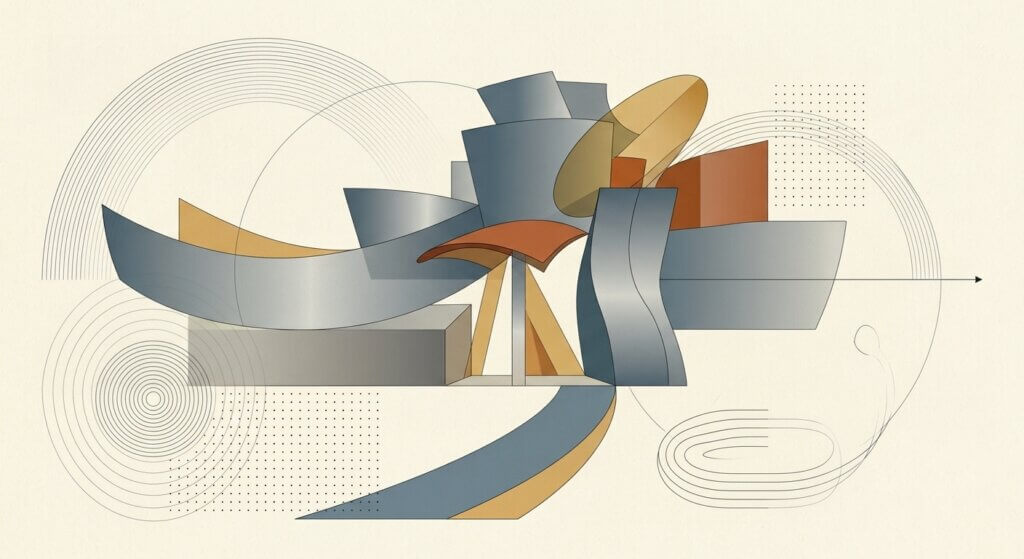
Frank Gehry had a problem that architecture could not solve.
In the nineties, Gehry wanted to build buildings with curves that no architectural tool knew how to describe. The Guggenheim in Bilbao, with its rippling titanium skin, was literally undrawable. There was no way to describe those curves precisely, nor to translate them into the tens of thousands of titanium panels (around 33,000 of them, 80×115 cm) that would clad it, each one a unique shape.
The solution did not come from architecture. It came from aeronautics.
Gehry adopted CATIA, software Dassault had built to model the fuselage of fighter jets. He realized that describing the curve of a wing and describing the curve of a building were, at bottom, the same problem. By learning the tool and the logic of the aeronautical engineer, he made his own architecture possible.
Notice what he did not do.
He did not stop being an architect. He did not start building planes. He did not replace Dassault’s engineers. He took hold of another discipline in order to expand his own, and he respected it enough that he ended up founding a technology company to take it further.
Knowing someone else’s work made his own work better, without him having to take anyone’s place.
What is happening now
This story describes exactly what AI is doing to the roles inside product teams. And what it is doing is not always what it looks like.
AI has collapsed the distance between disciplines. Today a designer vibe codes and has a working app. A product manager opens Figma and puts together a prototype. An engineer generates the interface, writes the copy, and does without marketing. All of a sudden, everyone can produce everyone else’s artifact.
On the surface, it looks like Gehry. Each person stretching past their own border, becoming more complete.
Most of the time, it is not.
The difference between learning and occupying
Gehry learned the aeronautical engineer’s discipline so he could decide better in his own lane. He stayed the architect. The engineer stayed necessary.
The AI-accelerated version is different. It tries to get you to produce someone else’s output without someone else’s judgment, and to do without the person who had that judgment. Being able to generate an interface makes nobody a designer, the same way throwing a barbecue makes nobody a chef.
The tool put execution within anyone’s reach, but mastering the problem it solves still takes years.
The work that disappears without anyone noticing
There is a hidden cost in this, and it is the most dangerous one.
When a product manager spends the day making prototypes, the work that defines the role stops being done: clarifying the problem, aligning across disciplines, deciding what deserves to exist. It is work nobody sees and nobody applauds, and it is often the work that decides whether a product lives or dies.
I saw someone the other day sum this up better than any report could. He had four apps published on the App Store and five more in development. Total revenue across all of them was zero. His users, in his own words, were roughly his wife and a guy in Finland he suspected had downloaded the app by mistake. He built everything. It mattered to nobody.
And here is what worries me most. Companies rarely fail because they build slowly. What usually kills them is becoming extraordinarily efficient at building the wrong thing.
AI is the best accelerator we have ever had. It accelerates this too.
Notice the order on Gehry’s side. The question came first: which building is worth building. CATIA came after, to serve it. Never ahead of it.
The good version exists
I want the exact opposite of shutting everyone into their own box.
The designer who understands engineering makes better decisions. The product manager who understands design arrives at sharper problems. And an engineer who has spent an afternoon watching real users fail with the product writes different code the next day. Knowing the lane next to yours makes you better in your own.
That is Gehry. The line is subtle, and it is everything that matters: learn someone else’s work so you can decide better in yours, without falling for the illusion that you no longer need them.
I feel this in my own skin. I have spent months building a running training app on my own, with AI. I am the designer, the developer, the product manager and the only test user. It is intoxicating, and it is also a trap: on the bad days, I produce the wrong thing quickly, and very well made.
AI may not have given me my colleague’s judgment, but it gave me his tools and access to what he knows. Learning to use it well is still my job.
And that is why knowing someone else’s work is what keeps us needing each other.
Notes and sources
Priceonomics — The Software Behind Frank Gehry’s Geometrically Complex Architecture
The B1M — The Guggenheim Bilbao was revolutionary
Dezeen — Guggenheim Museum Bilbao
Dassault Systèmes — Frank Gehry, CATIA and the Digital Making of Guggenheim Bilbao